

The Belarusian People's Congress is the guarantor of political stability and sovereignty
Events
Belarus’ deputy economy minister outlines preliminary 2026 economic results
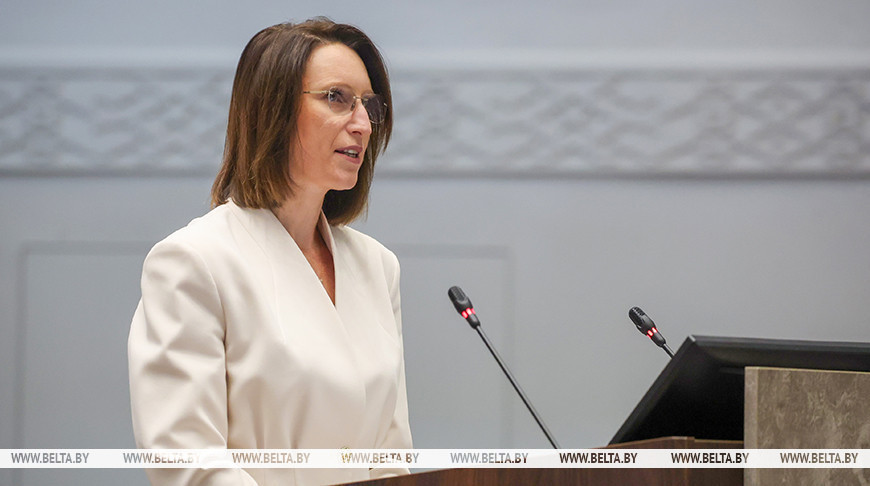
MOGILEV, 12 November (BelTA) – Belarusian Deputy Economy Minister Maria Mazhinskaya spoke to journalists about the preliminary results of 2026 following a meeting of the Mogilev Oblast Executive Committee dedicated to the region’s socio-economic development in January–September and the implementation of the regional socio-economic development program for 2026–2030, BelTA has learned.
The deputy economy minister noted that, overall, the results can be described as positive.
“The country’s GDP is growing: it has already reached $108 billion, and investments have increased to $21 billion,” she said.
However, the key indicator is the well-being of the population. “Today, salaries have exceeded $1,000. This is a serious benchmark for us. But we are not stopping there; we are moving forward,” the deputy minister emphasized. “The low-income population rate stands at a record low of 3.2%.”
People remain at the heart of state policy, and as Maria Mazhinskaya stressed, everything starts with quality education – which, in today’s world, must be practice-oriented. “To achieve this, the emphasis is placed on cooperation between education, science, and the real economy. Training workshops are being opened at enterprises. Today there are already 28 of them, and we plan to open 22 more by the end of the year,” she said. “Including in Mogilev Oblast, such workshops are opening at enterprises to allow personnel to quickly and promptly get into the swing of things. In addition, so that young people can enter the labor market faster, we have revised training requirements and shortened training periods for 640 professions. We have also eliminated the requirement for formal education for certain blue-collar jobs.”
Training specialists at a fundamentally new level will be a strategic step toward a technological breakthrough. The Academy of Intelligent Technologies will serve as a hub for top-tier talent in natural sciences, industrial and digital technologies, and other promising fields, welcoming its first students on 1 September 2027.
To ensure equal opportunities for everyone, Belarus is actively developing infrastructure for families with children. “In 2026, four new schools were built, including one in Mogilev, and five more were renovated. Furthermore, to help mothers quickly re-enter the labor market, we are introducing 1,000 kindergarten groups with flexible schedules. This allows a mother to balance raising her child with working and fulfilling her potential, which will drive the development of both individual regions and the country as a whole,” she noted. “This is essential for ensuring the overall competitiveness of our economy, producing high-quality goods, and developing new high-tech industries.”
Investment projects are also being implemented across the country. “To date, a pool of 35 projects has been selected. We plan to complete four projects this year. Major projects are also underway in Mogilev Oblast that are significant for the entire country. These include a project at Mogilevkhimvolokno and a project at the Osipovichi Automobile Units Plant. This will give a new impetus to the development of certain districts and the region as a whole,” she said.
All of this shows that both the quality of the economy and the quality of life of the population are changing. “Overall, we can already speak of the success of 2026. The head of state has set tasks for 2027 for the country as a whole, as well as for Mogilev Oblast. We are working to achieve everything,” she said.


